
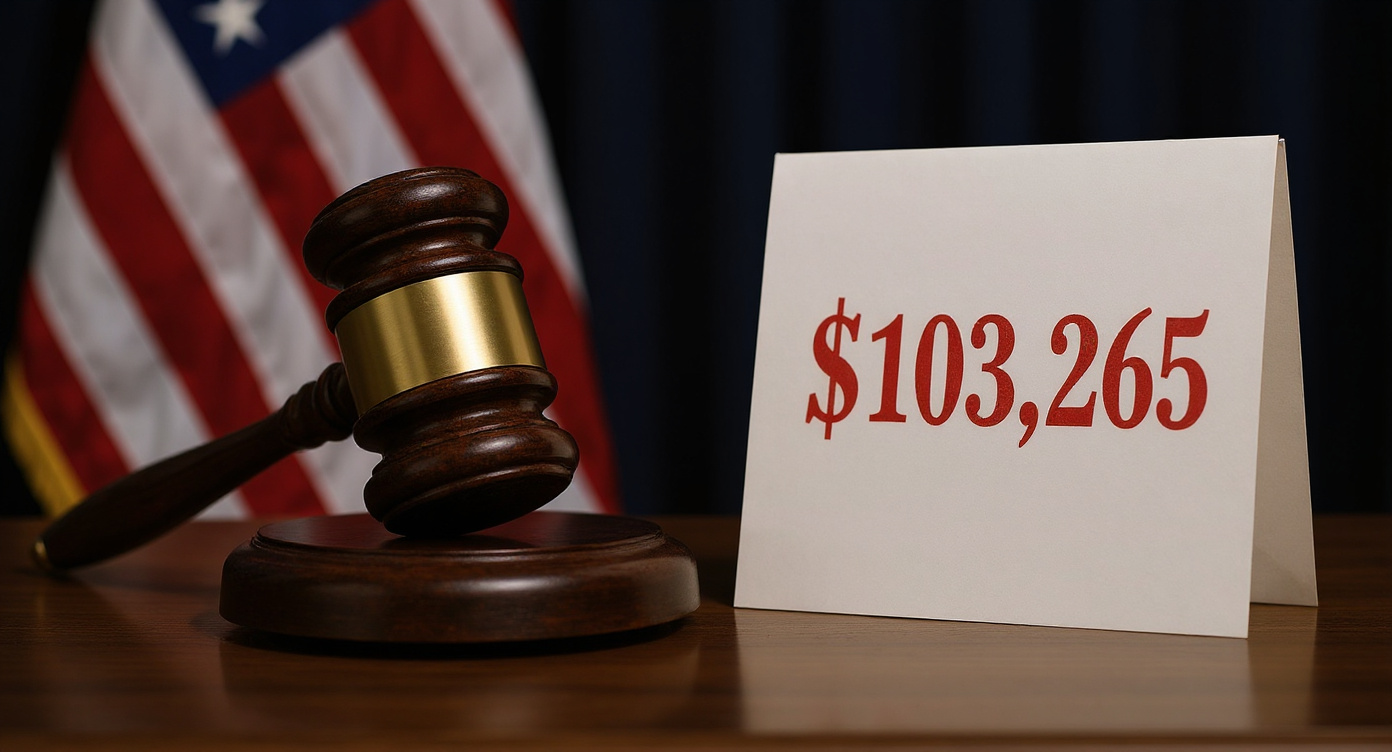
In September 2025, President Trump signed a proclamation slapping a $100,000 fee on cap-subject H-1B visa petitions. A Massachusetts federal judge struck it down on June 8. Three days later, the administration filed an appeal with the First Circuit Court of Appeals.
Then, just to make sure the point landed, they came back with a new fee: $103,265.
The Department of Homeland Security published the proposed rule in the Federal Register, and the math is almost comically direct. DHS identified $8,777,488,035 in total costs across the federal government for adjudicating, vetting, and supporting H-1B programs. Divide that by the 85,000 cap-subject petitions issued annually and you get $103,265 per petition. The expected annual revenue: $8.8 billion.
USCIS Spokesman Zach Kahler explained the logic: "The proposed H-1B fee is intended to recover the costs incurred across the federal government to adjudicate, vet, and support lawful immigration programs that otherwise must be funded by taxpayers." In other words, if you want to import cheaper labor, you're going to pay the actual cost of the paperwork instead of passing it to American taxpayers.
And "cheaper labor" isn't editorial commentary. Harvard economist George Borjas has documented the wage gap: H-1B workers earn 16.1% less than their American counterparts in equivalent positions. The program was sold as a way to fill jobs Americans can't do. The data says it fills jobs Americans could do — for less money.
DHS was remarkably candid about the intended effect. Their own statement said that "U.S. employers, if required to pay an additional $103,265 fee when filing an H-1B cap-subject petition, would be less likely to hire an H-1B worker over a qualified and highly-skilled American worker unless the need is legitimate." That's the federal government admitting, in writing, that many current H-1B hires aren't legitimate needs.
The numbers on the demand side tell the story. In FY2026, there were 343,981 H-1B registrations competing for just 85,000 slots — 65,000 regular and 20,000 for advanced degree holders. That's a four-to-one ratio. The program isn't filling desperate shortages. It's running a labor discount warehouse.
The new rule includes a 30-day public comment period, and exemptions for universities, governmental research organizations, and qualifying nonprofit research groups. In FY2025, 28,649 entities filed as small businesses, with 11,051 of those directly affected by cap-subject requirements. Those are real numbers, and the administration clearly expects pushback from that corner.
The legal strategy is deliberate — the previous proclamation relied on executive authority under INA Sections 212(f) and 215(a), while the new rule goes through formal notice-and-comment rulemaking under Sections 286(j) and 286(m). Different legal foundation, same destination, higher fee.