
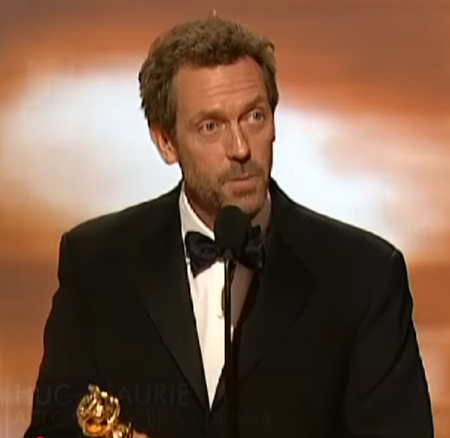
Hugh Laurie, the three-time Golden Globe winner best known for playing the brilliantly abrasive Dr. Gregory House, posted two words on X this week that racked up millions of views. They weren't polite. They were directed at comedian Graham Linehan, who had called Laurie "cowardly" for not being explicit enough about where he stood on men competing in women's sports.
Laurie got explicit.
"Firstly, f--- off; secondly no, I don't believe men should compete against women," Laurie wrote. When Linehan pressed further, Laurie didn't walk it back. He doubled down: "You started it. 'Cowardly' to 'f--- off' is the going rate of exchange around here. And yes, I support Sophie Cunningham."
Linehan, to his credit, took the punch. "Fair dos. I apologise for my knee-jerkiness. And thank you," he replied. The whole exchange played out in public on X, and it went exactly the way these things go when somebody in Hollywood accidentally says something true — it went nuclear.
The Sophie Cunningham in question is the Indiana Fever guard who set off a national firestorm back on July 21 when an ESPN profile included her thoughts on protecting women's sports. Cunningham didn't deliver some carefully workshopped PR statement. She said what 79% of Americans already believe, according to a March 2025 New York Times poll: biological men shouldn't compete against women.
"I think that I am here to extend love," Cunningham told ESPN. "But I also think with that love is truth, being honest. And I want to protect young girls in a locker room, or young girls in sport who shouldn't have to go against biological men."
The backlash was immediate and predictable. Rallies outside Fever games. Statements from the WNBPA. The full online mob treatment. Cunningham addressed it directly: "I got a lot of negative feedback about me hating trans. And I'm like, 'I never once said that.'"
She didn't. But that doesn't matter to the enforcement arm of progressive orthodoxy. The crime isn't what you said. The crime is that you said anything at all that deviated from the script. Cunningham described herself as "very much in the middle," someone who agrees "with things on both sides" and disagrees "with things on both sides." In 2026, the middle is a radical position.
What makes Laurie's entry into this interesting isn't just that he's famous. It's that he's British, established, and operates in a tier of Hollywood where the usual leverage doesn't apply. Comedian and political commentator Tim Young put it bluntly: "Laurie can't be canceled." Young added, "It's so rare that someone from Hollywood would stand up for women in women's sports that it's exciting when someone does at this point."
That rarity is the story. We're not talking about some fringe position. Nearly four out of five Americans agree with Cunningham and Laurie. The White House has publicly defended Cunningham's right to speak on this. A New York Times poll — not exactly a right-wing operation — confirmed the supermajority. And yet the cultural pressure is so intense that it takes a three-time Golden Globe winner with nothing left to lose to say what a WNBA player already said, and it's treated as breaking news.
Young made another observation worth noting: "Comedians always stand at the forefront of social commentary, but many of their opinions come from who pays them." That's the quiet part. The entertainment industry doesn't punish people for having bad opinions. It punishes people for having expensive opinions — the kind that make sponsors nervous and publicists send 2 a.m. texts.
Cunningham didn't have the luxury of being uncancelable. She's a working athlete in a league that depends on corporate partnerships with companies that fly pride flags in June and pretend they don't exist in July. She said what she believed anyway. Laurie just made it harder for the next person to pretend nobody credible agrees with her.
When 79% is the minority position in your industry, the problem isn't the 79%.