
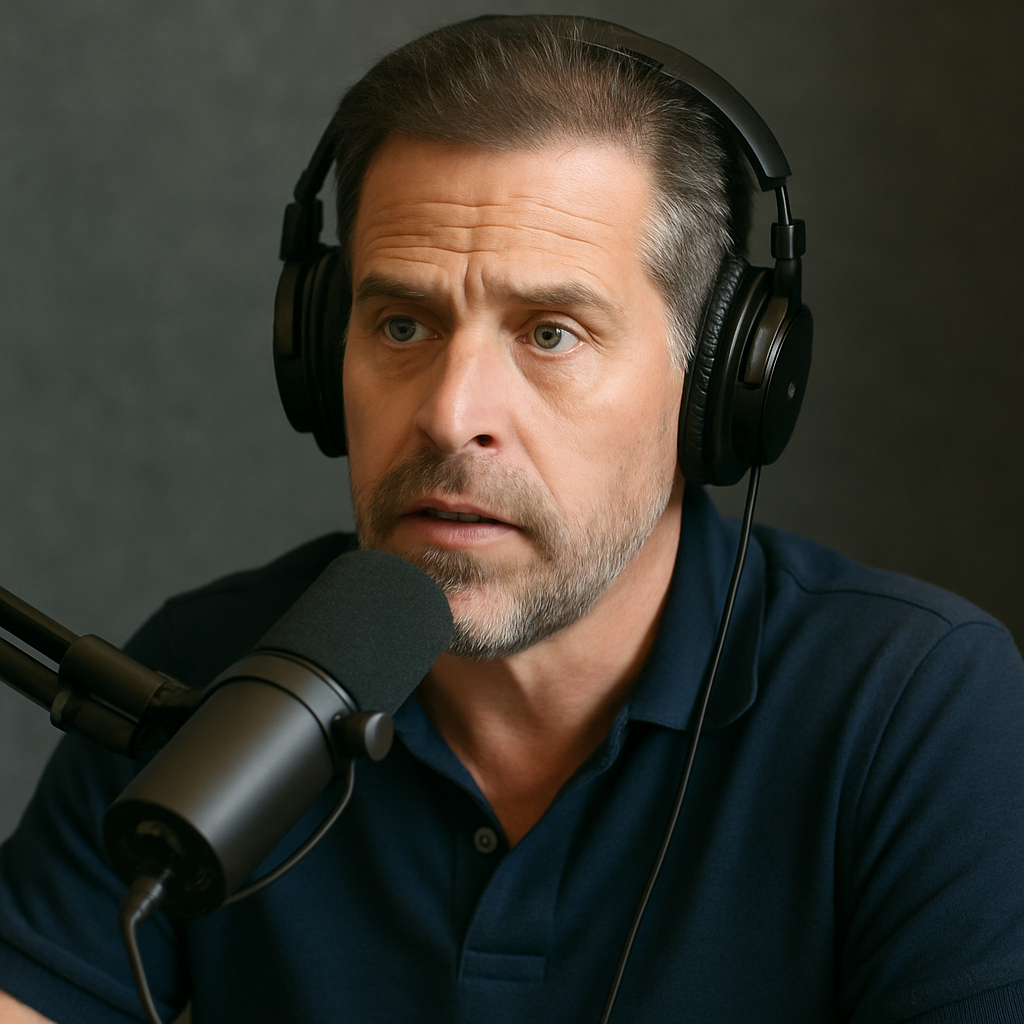
Hunter Biden walked into a Santa Monica recording studio, sat down across from a podcast host, and explained on tape how he kept collecting up to $50,000 a month from a Ukrainian energy company while in the grip of a crack addiction.
His defense? The job wasn't that hard.
"Even when I was a crack addict and out of my mind, I could show up for four meetings a year," Biden told Dave Manheim on the "Dopey" addiction and recovery podcast. Four meetings. Fifty grand a month. From a Ukrainian energy company that just happened to need the son of the sitting Vice President of the United States on its board.
Biden joined the board of Burisma in 2014 and stayed until 2019 — a period that neatly overlapped with his father Joe Biden's time as Vice President. When asked whether his addiction ever left him broke, Hunter was remarkably candid. "I never went broke," he said. "Well, I still had the residual. Like for instance, I still was on the board of Burisma."
The residual. That's what we're calling it now. Most people's "residual" is a savings account or maybe a tax refund. Hunter Biden's residual was a five-figure monthly payment from a foreign energy company in a country where his father was the Obama administration's point man on anti-corruption policy.
Biden attempted to frame the Burisma gig as just another line on a long résumé. "What people don't understand about Burisma is that I went on the board of Burisma because I had been on the board of about 14 other major national and international organizations," he said. He cited his time as chairman of World Food Program USA, vice chairman of Amtrak, faculty at Georgetown University, and counsel at Boies Schiller Flexner. He insisted he was "not running some kind of international crime syndicate."
Nobody said crime syndicate. The question was always simpler: what, exactly, did Burisma get for $50,000 a month besides a last name?
Fourteen boards is a fascinating detail — not because it makes the Burisma appointment look more legitimate, but because it raises the same question fourteen more times. Were all of those positions filled on merit? Or does Washington run an entire economy around monetizing proximity to power, and Hunter Biden just happened to be better positioned than most?
The timing of this podcast appearance is worth noting. In June 2024, a federal jury convicted Hunter Biden on three felony gun charges. He later entered a plea on separate federal tax charges. Then in December 2024, Joe Biden issued a presidential pardon covering any federal offenses Hunter had committed or "potentially committed" between January 1, 2014 and December 1, 2024 — a window that covers the entire Burisma period, every tax issue, every gun charge, and anything else that might have surfaced.
That's the pardon that made this podcast possible. When every federal crime you may have committed across a full decade has been pre-forgiven by your father on his way out the door, you can afford to be chatty in a Santa Monica recording studio.
The "Dopey" interview was framed as a conversation about addiction and recovery, and credit where it's due — addiction is brutal, and talking about it publicly takes something. But Hunter Biden didn't just talk about addiction. He volunteered a detailed explanation of how he maintained a $50,000-a-month board seat at a foreign energy company while, by his own description, being "out of my mind" on crack.
Four meetings a year. No legal consequences. A pardon so broad it covers offenses that haven't even been alleged yet.
A system working exactly as designed — just not for the people it's supposed to serve.