
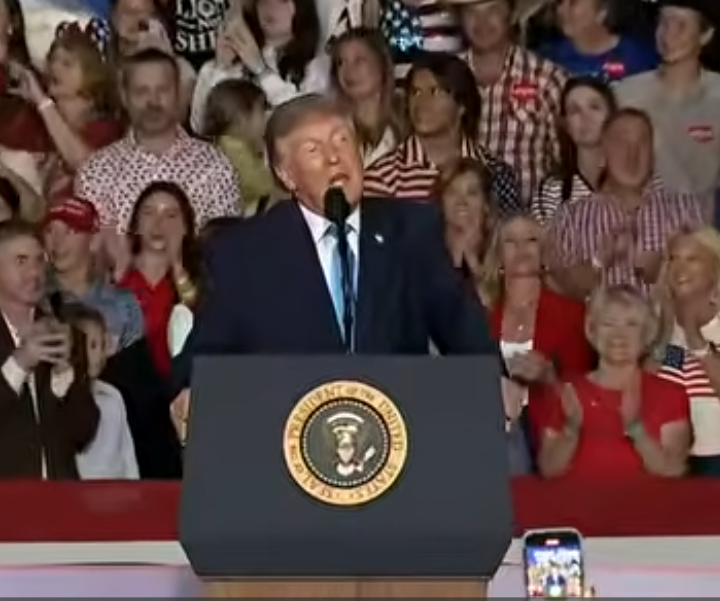
President Trump was talking about gas prices. Specifically, he was making the case that higher prices at the pump are a small price to pay if it means preventing Iran from developing nuclear weapons capable of reaching Los Angeles or San Diego. That's the statement. That's what the man said.
Within hours, the clip was edited, stripped of context, and circulated as proof that Trump had casually offered to let Iran nuke American cities.
The speed of the distortion was almost impressive. Social media accounts, blue-check commentators, and the usual anonymous aggregators began pushing the claim on October 6th that Trump had said he'd allow Iran to "take out" LA or San Diego — as though the President of the United States had shrugged at a nuclear strike on his own country during a public appearance. The framing required ignoring every word that came before and after the clipped segment.
Trump's Rapid Response team didn't bother being diplomatic about it. "No, he didn't, you buffoons," the official @RapidResponse47 account posted. "He was saying the U.S. is fighting to STOP Iran from having the ability to take out LA and San Diego with a nuclear weapon." Not exactly the kind of correction that leaves room for interpretation.
The technique here is one we've seen before — isolate a conditional statement, remove the condition, present the consequence as the position. Trump says "we can't let Iran get a weapon that could take out Los Angeles." The clip starts at "take out Los Angeles." The sentence loses its subject, its verb, and its entire point. What remains is a sentence fragment that sounds like permission instead of prevention.
The full remarks make the argument unmistakable: the Iranian nuclear program represents a direct threat to American cities, and the economic cost of confronting that threat — including elevated gas prices — is worth paying. That's a hawkish national security position. It's the position the same media outlets spent four years demanding Trump take more seriously.
The people who clipped the video knew what the full quote said. They watched the same footage everyone else watched. They chose a start point and an end point that reversed the meaning of a sentence about protecting American cities from nuclear attack, then published it as though they'd caught a confession.
The full clip is public. The transcript is available. The correction came from multiple independent sources within hours. None of that will matter by Wednesday, when the clipped version will have ten times the reach of the real one.
That's not a media failure. That's a media product.