
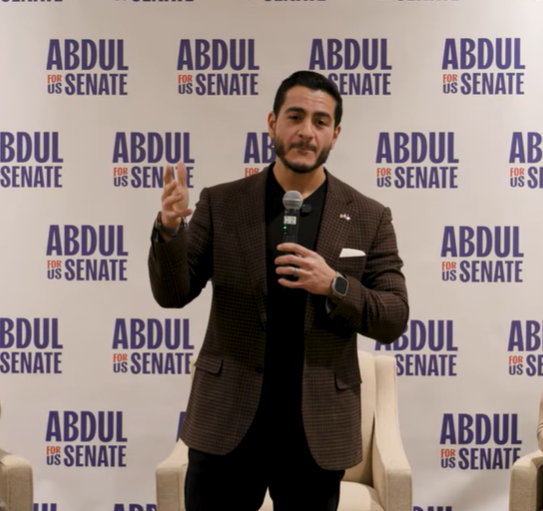
Abdul El-Sayed, the Democratic nominee for Michigan's U.S. Senate seat, has collected $115,000 in donations from members of the Council on American-Islamic Relations. CAIR — the organization whose own co-founder, Omar Ahmad, chaired a group that grew directly out of a Hamas support network in the United States.
But sure, CNN says he's a moderate capitalist. Must be true.
The reporting traces the money back through CAIR's founding history — and it's the kind of history that would sink any Republican candidate before the first commercial break. CAIR was formed in 1994, one year after a 1993 Muslim Brotherhood meeting in Philadelphia that the FBI had under surveillance. The organization's co-founder, Omar Ahmad, served as CAIR's chairman until 2005 and had previously been involved with the Islamic Association for Palestine, a Hamas-linked outfit.
None of this is ancient conspiracy theory. In 2004, the FBI seized a Muslim Brotherhood memorandum — written in 1991 — from the home of Ismail Elbarasse, a Brotherhood member and Hamas's U.S.-based archivist. That document laid out an explicit strategy for operating inside the West.
Arielle Klepach, senior litigation counsel for the National Jewish Advocacy Center, put it plainly during testimony before Senator Ted Cruz's Senate Judiciary Subcommittee on Federal Courts, Oversight, Agency Action, and Federal Rights: "The Muslim Brotherhood told us their strategy for the West... a kind of grand jihad in eliminating and destroying Western society from within."
That's not a paraphrase from a blog post. That's sworn testimony citing a seized document, delivered to a Senate subcommittee.
El-Sayed won Michigan's Tuesday primary and is now the Democratic standard-bearer for one of the most closely watched Senate races in the country. His primary opponent, Representative Hillary Scholten of Michigan, offered the kind of concession statement that reads like it was drafted by a focus group — pledging to "work with anyone committed to lowering costs, expanding affordable healthcare." Standard exit language. Nothing about CAIR. Nothing about the $115,000.
The media coverage since the primary has been equally careful. CNN ran a segment positioning El-Sayed as a mainstream capitalist, a doctor-turned-politician with crossover appeal. Capital Research Center and the Media Research Center have been doing the actual journalism — connecting donor records to organizational histories that major outlets have decided aren't worth mentioning.
Left-wing media defenders will call this guilt by association. Interesting framing. When $115,000 flows from members of an organization whose founding traces back through a Hamas support network, through a Philadelphia meeting under FBI surveillance, through a seized memorandum outlining infiltration strategy — that's not association. That's a paper trail.
The question isn't whether El-Sayed personally endorses every position CAIR has ever taken. Politicians take money from all kinds of groups. The question is why every major network that covered his primary victory managed to skip the part where his donor list includes six figures from an organization the FBI has formally linked to a Hamas support infrastructure. That's not an editorial oversight. That's a choice.