
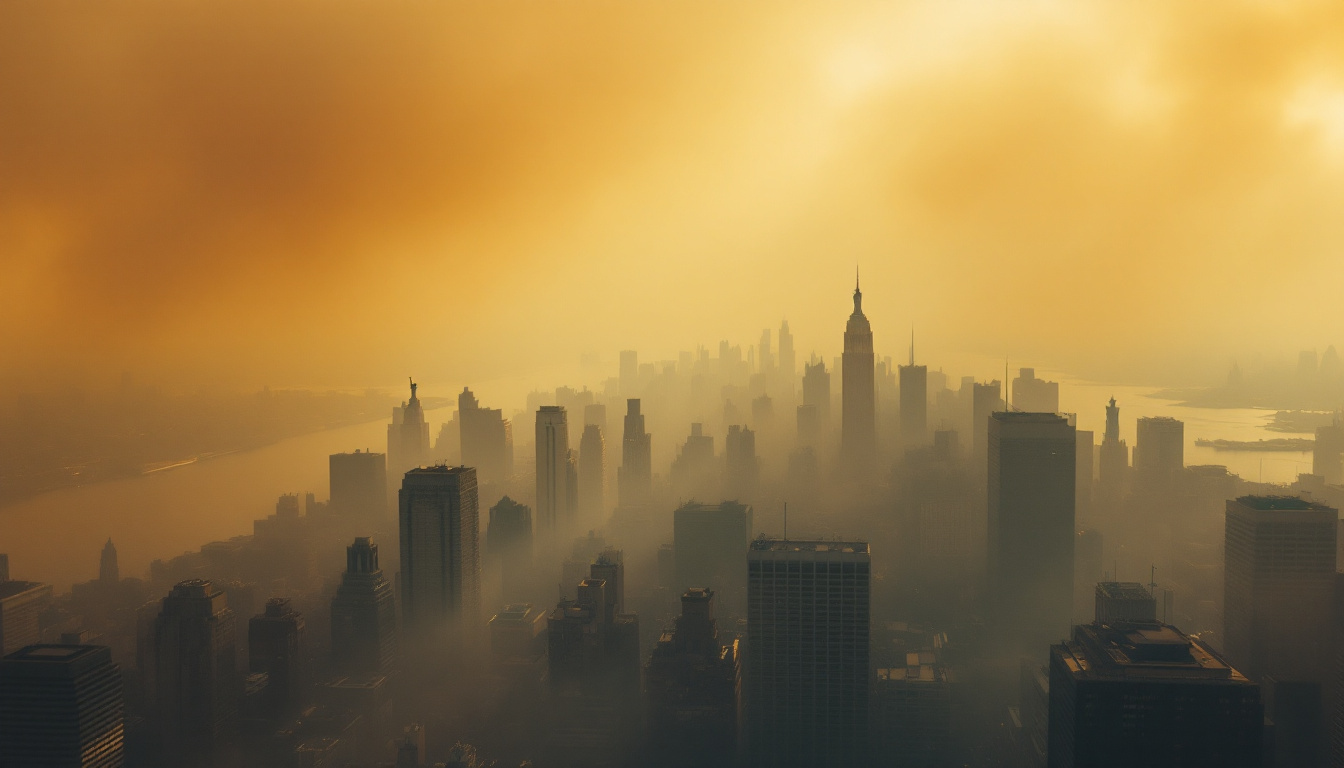
Early Wednesday morning, New York City ranked second only to Delhi, India for the worst air quality out of 100 tracked countries, according to Swiss air quality technology company IQAir. The city's Air Quality Index hit 160 — categorized as "unhealthy" for everyone, not just sensitive groups. Particulate matter in New York's air was measured at 14.5 times the World Health Organization's annual air quality guideline value.
Delhi. The city whose air pollution is a punchline for the entire developed world. And New York briefly had it beat.
The culprit is wildfire smoke pouring down from Canada, where more than 830 wildfires are currently burning. In northern Ontario alone, 185 active wildland fires are raging — 148 in the northwest region and 37 in the northeast — with 69 of them not under control. Year to date, Ontario has reported 453 wildland fires, compared to 349 at this point in 2025. The smoke has triggered air quality alerts across at least 17 states.
Governor Kathy Hochul issued an Air Quality Health Advisory for all regions of New York State on July 15, expanding it statewide as conditions worsened. The AQI forecast for the New York City Metro region on Thursday hit 200 — nearly double the alert threshold of 101 — making it the city's worst smoke event since June 2023, when skies turned orange and the AQI peaked at 480.
Mayor Zohran Mamdani's administration responded by keeping hundreds of cooling centers open and distributing free KN95 masks at all NYPD precincts, public library branches, and select FDNY firehouses across the five boroughs. The MTA handed out masks at Penn Station and Grand Central. The city's Department of Social Services activated a Code Grey and Code Red, dispatching outreach teams to connect homeless New Yorkers with air-conditioned spaces.
New York City Public Schools limited outdoor activities and rescheduled outdoor field trips. NYC Parks canceled many outdoor programs, including swim programs, and moved camp activities inside when possible. Health officials recommended that all New Yorkers limit strenuous outdoor activity, while children, older adults, and people with heart or lung disease were told to avoid unnecessary time outside entirely.
Mamdani said that "dangerous heat and smoke from Canadian wildfires have worsened air quality" and that New Yorkers needed to "be extra vigilant to stay safe." Fair enough. But it's worth noting that New York's approach to a recurring environmental crisis — this is the second major smoke event in three years — amounts to handing out masks and telling people to stay indoors. The same masks, incidentally, that government officials spent years insisting were unnecessary for a respiratory virus.
The broader picture is hard to ignore. IQAir's global rankings on Thursday afternoon placed Detroit, Michigan at the top with a staggering AQI near 570. Minneapolis, Chicago, and Toronto rounded out the top four worst air quality readings on the planet. American and Canadian cities occupying four of the top five spots on a list usually dominated by South Asian industrial centers is not a data point any governor's press release is eager to highlight.
One of northern Ontario's largest active fires, designated Red Lake 24, has burned approximately 3,079 hectares and remains not under control. Several areas are under evacuation orders, including Armstrong, Ontario, along with several First Nations communities. Highways are closed. Residents are fleeing. And the smoke just keeps drifting south.
Conditions are expected to improve to at least "moderate" through the weekend, according to IQAir. But "moderate" is a relative term when last week you were breathing air that made Delhi look competitive. The 2023 event peaked at 480 and produced weeks of public health anxiety. This one is forecast at 200 and climbing.
Three years ago, the orange skies over Manhattan were treated as an unprecedented emergency. Now it's a recurring event with a playbook: masks at the precinct, cooling centers open, schools move recess inside. The air clears, the press releases stop, and nothing changes until the next time Canada catches fire.