
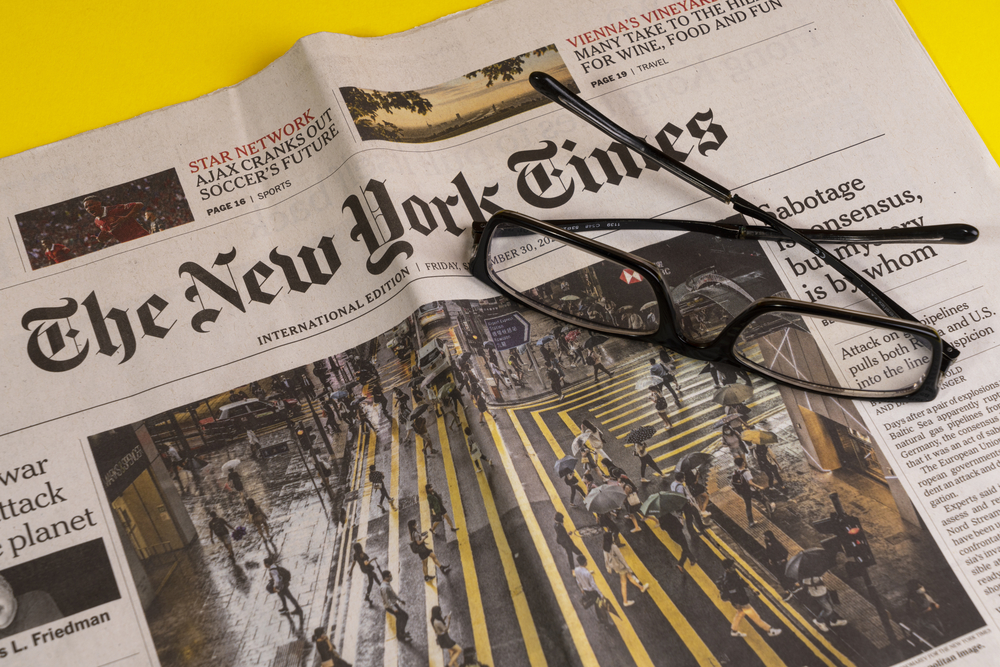
A co-pilot on a FlyDubai flight carrying approximately 180 passengers — mostly Israeli — from Dubai to Tel Aviv attempted to hijack the plane and crash it 9/11 style to kill everyone on board. The New York Times and many other left-leaning media outlets described the event as "a plane flying from Dubai to Israel was diverted after an altercation between the pilot and co-pilot."
An altercation. Like the two pilots disagreed over what to get for lunch.
When the backlash hit, the NY Times didn't correct the headline. They didn't acknowledge that describing an attempted terrorist hijacking of a commercial aircraft as an "altercation" might understate the situation by a factor of about ten thousand. Instead, NYTimes Communications — the paper's official PR account — fired back with this: "Unlike activists and partisans, we don't publish speculation or unverified information."
That's where James Woods entered the conversation. The actor, who has become one of the sharper political voices on social media, responded with a single sentence that did more damage than a thousand op-eds could: "You won the Pulitzer Prize for relentlessly pushing the very hoax for which Adam Schiff was censured by the House."
That's not a comeback. That's a coroner's report.
The facts Woods is referencing aren't disputed by anyone outside the Times' own newsroom. The New York Times won its Pulitzer for coverage of the Russia collusion narrative — the same narrative that turned out to be built on opposition research, anonymous sourcing, and precisely the kind of unverified speculation the paper now claims it never publishes. Representative Adam Schiff, who spent years on cable news claiming he had direct evidence of Trump-Russia collusion, was formally censured by the House of Representatives when none of that evidence materialized.
The Times kept the Pulitzer. Schiff got censured. And now the same publication wants credit for editorial restraint.
What makes the FlyDubai incident so revealing isn't just the sanitized headline. It's the pattern. When the subject involves Israel, terrorism, or any story where the plain facts might lead the reader to a conclusion the Times would rather they not reach, the language gets softer. "Altercation" instead of hijacking attempt. "Militants" instead of terrorists. "Tensions" instead of war. The vocabulary isn't neutral — it's engineered to flatten the story into something that doesn't point anywhere uncomfortable.
A co-pilot on a commercial flight with 180 people aboard tried to commandeer the aircraft. That's not an altercation. That's an attempted mass casualty event at 35,000 feet. Every passenger on that plane knows the difference, even if the Times' headline desk pretends not to.
The "we don't publish speculation" defense would land differently if the paper hadn't spent years publishing exactly that on the biggest political story of the decade. Woods didn't need to lay out the full timeline or cite the Mueller Report's conclusions. He just needed one sentence, because everyone already knows the record. The Times published. Schiff talked. The evidence didn't exist. The Pulitzer stayed on the shelf.
The ratio on the NYTimes Communications post told the rest of the story. When your institutional defense of journalistic standards gets dismantled by an actor in fewer words than your own headline, the problem isn't Twitter. The problem is the headline.
The Times still has that Pulitzer. Adam Schiff is still in the Senate. And a terrorist hijacking attempt is still, according to the paper of record, an altercation.