
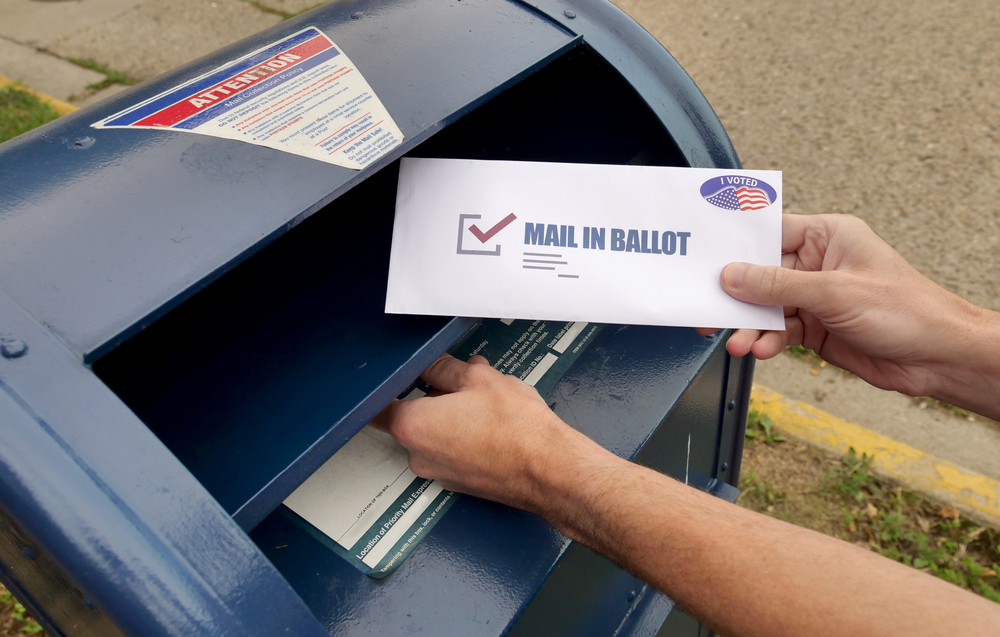
North Carolina started mailing ballots on September 5th. One day earlier, a federal judge in Boston made sure nobody would be checking who those ballots actually go to.
The timing wasn't an accident.
U.S. District Judge Indira Talwani — appointed by Barack Obama — issued a preliminary injunction on September 4th blocking the U.S. Postal Service from implementing a new rule that would have required states to verify mail-in ballot recipients through a USPS electronic portal. The rule, finalized in late August, would have required states to submit ballot and return envelope designs for USPS approval, upload voter names and addresses to the portal, include intelligent mail barcodes on envelopes, and certify receipt of design approval before ballots went out.
In other words, basic tracking and verification for the roughly one-third of American voters who now cast their ballots by mail. The kind of chain-of-custody stuff FedEx does with a pair of sneakers.
Talwani ruled that implementing the system less than seventy days before the November 3rd midterm election "threatens disenfranchisement of millions of United States citizens who seek to vote by mail." She wrote that plaintiff states are "required under state law to mail millions of ballots" and are "unable to pivot this late in the election cycle, nearly guaranteeing disenfranchisement."
The Trump administration's position is straightforward. The executive order, issued back in March, was designed to stop illegal voting by non-citizens. The USPS rule was the implementation mechanism — states upload their voter rolls to the portal, USPS cross-references before delivering ballots. Solicitor General John Sauer argued that Talwani's order "risks sowing confusion and chaos because it makes those preparatory steps voluntary, and not mandatory."
Sauer has a point that the judge's ruling doesn't acknowledge. Making a security system optional is the same as not having one. Every state that skips the portal — which, according to PBS, is currently all of them — sends ballots into the same unverified pipeline we've had since 2020. The portal doesn't prevent anyone from voting. It prevents ballots from being mailed to addresses where eligible voters don't live.
The legal argument against the rule boils down to this: the Constitution grants states and Congress the power to set voting procedures, not the president. Which sounds reasonable until you remember that the Postal Service is a federal agency delivering federal election materials. The idea that USPS can set delivery standards for Amazon packages but not for ballots carrying the weight of democratic self-governance is a position you have to go to law school to find persuasive.
The administration filed an emergency application with the Supreme Court on September 6th asking the justices to lift the injunction. The 1st Circuit Court of Appeals is also expected to weigh in. Challengers have until Wednesday after 4 p.m. ET to file their briefs.
This is the third round of this fight. Talwani first blocked the order in June. The Supreme Court overturned that block in August on procedural grounds — without ruling on the merits. The Postal Service then finalized its implementation rule in late August, and Talwani blocked it again within days.
The pattern is familiar. An administration proposes an election security measure. Opponents run to a friendly court. The judge finds the measure threatens "disenfranchisement" — not because it prevents eligible voters from casting ballots, but because it adds a step between requesting a ballot and receiving one. The word "disenfranchisement" does a lot of heavy lifting in that framework. It transforms any verification requirement into a constitutional injury.
Experts have noted the portal system wasn't fully tested before the rule was finalized. That's a legitimate logistical concern. But the response to an untested system is to test it faster, not to abandon the concept of tracking who receives a ballot sixty days before a national election.
Somewhere around 65 million Americans voted by mail in the last presidential cycle. The number has only grown. We verify identities to board a plane, open a bank account, and buy Sudafed. The one thing we apparently cannot verify is whether the person receiving a ballot is the person who's supposed to vote with it.
That's not a legal principle. That's a preference.