
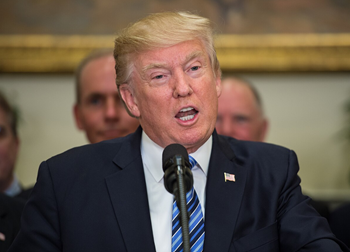
Roughly 1,600 people packed the Washington National Cathedral on Monday to say goodbye to Senator Lindsey Graham, the South Carolina Republican who died suddenly on July 11 at the age of 71. The cathedral opened with "How Great Thou Art." Then President Trump stepped to the podium and did something almost nobody in Washington knows how to do anymore.
He told the truth about his friend.
"He was extremely hawkish," Trump said of the 33-year Air Force veteran who retired as a Colonel. "He never saw a war he didn't like. He did it for the good of our country; he felt in his bones that our destiny is to win. His job was to do everything he could to ensure our enemies would lose."
That line is going to make the media rounds as some kind of gaffe. It wasn't. It was Donald Trump standing at a funeral and refusing to sand down the edges of a man who spent his entire career being exactly who he was. Graham was hawkish. Everybody knew it. Graham knew it. The idea that you're supposed to pretend otherwise because someone died is one of those Washington customs that exists to make the living feel comfortable, not to honor the dead.
Trump called Graham "a respected statesman, a giant of the United States Senate and a true American original who left us much too soon." He noted that Graham rose from a small town in rural South Carolina to become a force in American politics, and that "nothing of consequence happened in this Capitol without Lindsey Graham knowing about it."
He wasn't wrong about that either. Love him or not, Graham had his fingerprints on virtually every major national security debate for two decades. The man did not sit on the sidelines.
"He died doing the work he was born to do," Trump said. "He was truly a great politician." And then the line that landed hardest: "He was a man who gave America a measure of his good and mighty heart until that heart itself just gave out."
Sean Hannity followed Trump to the podium and offered a slightly different frame. Hannity pushed back on the "warmonger" label that had trailed Graham for years. "He was often unfairly characterized as a warmonger," Hannity said. "The truth was the opposite." Hannity argued that Graham's hawkishness came from moral clarity, not bloodlust, and pointed to Graham's private advocacy with Trump for peace in the Middle East. "Lindsey desperately wanted — and talked to the president about — a lasting peace in the Middle East," Hannity said. "He wanted every region, every country in the region, on that path to peace."
Graham's niece, Emillie Boggs Roberts, also delivered a tribute. Israeli Prime Minister Benjamin Netanyahu and Ukrainian President Volodymyr Zelenskyy attended the service, both of whom held closed-door meetings with Trump just hours before the funeral. Senate Majority Leader John Thune was there. South Carolina Attorney General Alan Wilson was there. Democratic Senators Chris Murphy of Connecticut and Ruben Gallego of Arizona were there. Salem Radio Network host Scott Jennings was there. Reverend Franklin Graham and Tony Perkins gave readings.
Trump's eulogy wasn't a roast. It was respect. The kind of respect that says "I knew you, I'm not going to pretend you were someone else, and I'm going to miss the actual person."
Graham served 33 years in the Air Force. He served decades more in the Senate. He had unwavering faith in the righteousness of American power, as Trump put it. He was not always popular with Republican voters, and we all know why. But he showed up every single day believing he was doing the right thing for the country he loved.