
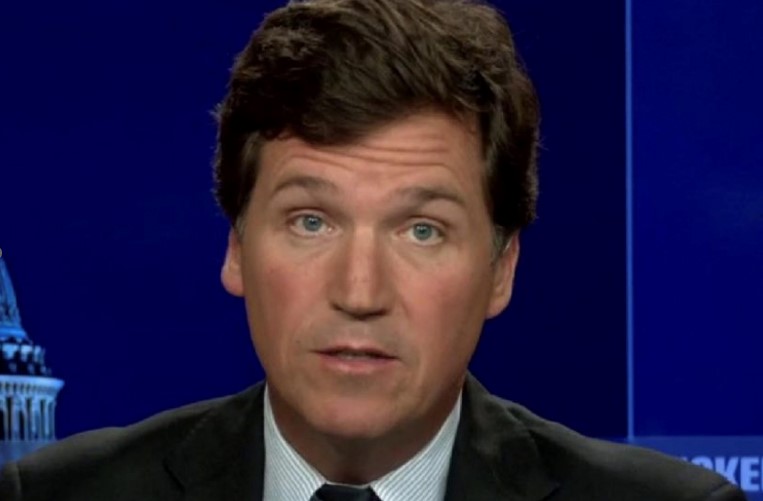
Tucker Carlson voted Republican for 35 years. He defended the party on cable news when defending the party wasn't cool. He endorsed Donald Trump and helped build the MAGA coalition into something that actually won elections.
Now he says he's done.
"There's no chance I would support the Republican Party," Carlson said on the "Can't Be Censored" podcast, which aired June 18. "I'm out."
The breaking point, according to Carlson, is foreign policy — specifically, what he describes as the GOP putting Israel's national security interests above America's. He pointed to U.S. involvement in Iran as the final straw, calling it "immoral" and characterizing the conflict as one America has "effectively lost already."
"How could I or any American voter support a political party that's not loyal to the United States?" Carlson asked. "That puts the interests of a foreign country above those of its own citizens."
This isn't some random podcaster venting. Carlson was fired from Fox News in 2023, where he'd earned $10 million annually, but despite losing access to millions of viewers a night he has remained a very popular influencer within the GOP. He's also rebuilt his brand and audience in the years since he last appeared on cable television. When he says "if I'm out, then I think a lot of other people are out," that's not a prediction. That's a weather report.
President Trump pushed back on the premise. "If anything, I might've forced Israel's hand," Trump told the Financial Times in March. "I call the shots. He doesn't call the shots" — referring to Israeli Prime Minister Benjamin Netanyahu.
Carlson went further in February 2026, publicly apologizing for endorsing Trump's campaign after U.S.-Israel strikes on Iran began. He called Trump a "slave" to Netanyahu and Israeli interests, and advocated for what he termed U.S. "detachment from Israel," labeling the alliance a strategic liability. Some critics have characterized those remarks as antisemitic. Carlson hasn't walked them back.
Rep. Marjorie Taylor Greene weighed in on X, acknowledging that conservatives feel the party has "betrayed its voters and country" — though she clarified they aren't becoming Democrats. That's the awkward middle ground a lot of the base currently occupies: furious at the party, unwilling to leave the movement, and unsure what the difference is anymore.
Then Glenn Beck stepped in with the kind of warning Washington Republicans should probably tattoo on their forearms.
"I told you this would happen," Beck said on The Glenn Beck Program, addressing Republican leadership directly. "When somebody like Tucker walks, when the next one walks — and there will be a next one — people are going to come and say, 'Circle the wagons. You've got to defend the party.' No. Don't rush to defend the GOP."
Beck wasn't done.
"You're not going to survive this," he continued. "And I don't mean a tough cycle coming your way. I mean, you are building with your own hands a movement aimed directly at you, and you deserve it."
That's not a pundit doing a hot take. That's an autopsy delivered to a patient who's still walking around.
The instinct in moments like this is to pick a side — either Tucker is right to walk, or he's being reckless and handing ammunition to the left. But the more useful question is what made a 35-year Republican voter conclude there was nothing left worth defending. That question has an answer, and Washington Republicans know exactly what it is. They just don't want to say it out loud because the answer implicates them.
Beck's warning lands harder than Carlson's exit precisely because Beck isn't leaving. He's standing inside the building, pointing at the cracks in the foundation, and telling the architects they poured the concrete wrong.
Carlson built his audience by saying what Republican voters were thinking. If he's thinking this, the party's problem isn't one podcast. It's the silence from everyone who agrees with him but hasn't said it yet.